-
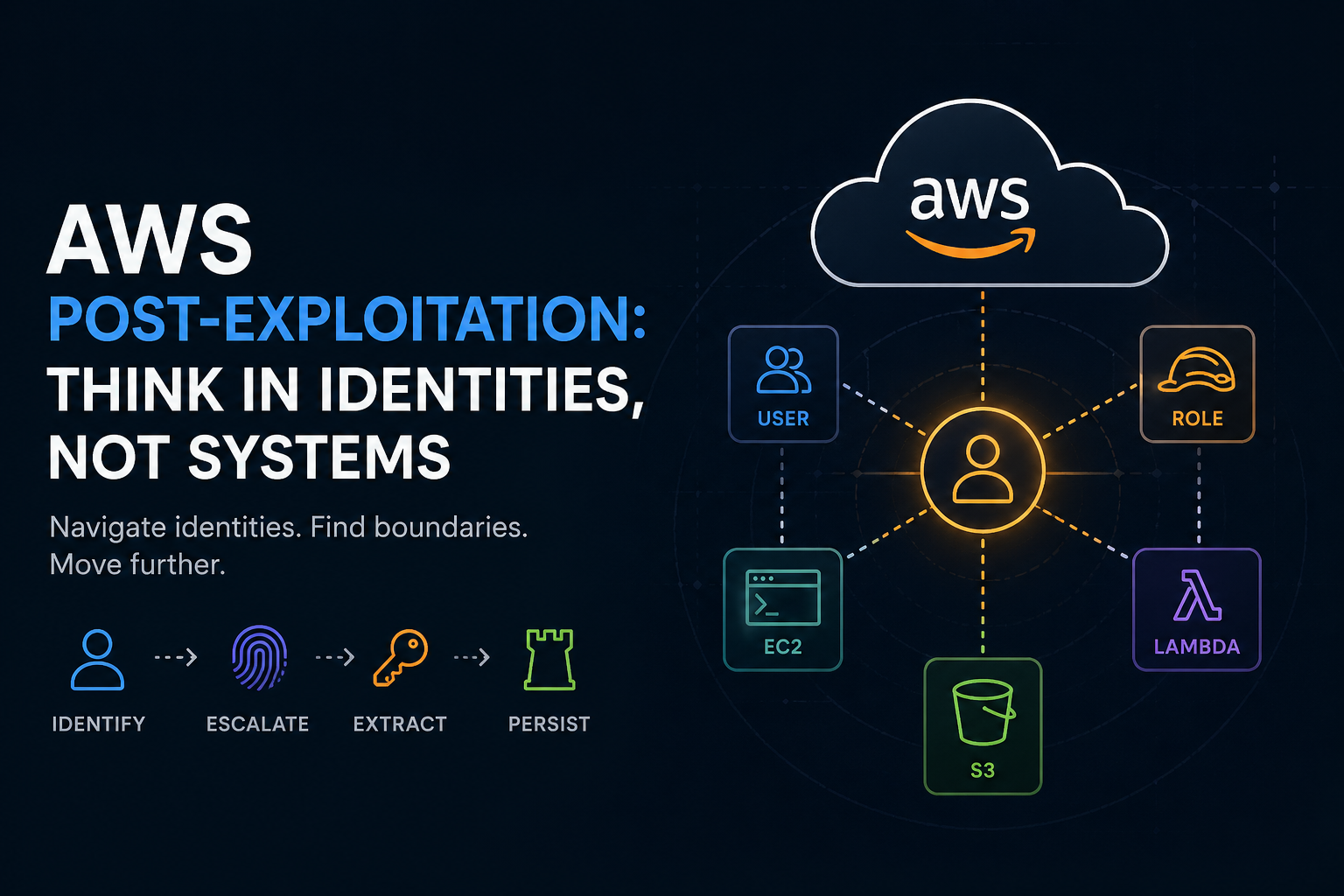
Protected: AWS Footholds: What You Actually Do After You Land.
There is no excerpt because this is a protected post.
-

Behind the Curtain: Building a Realistic Red Team Lab
Disclaimer: This blog post is intended for educational purposes only. It is not suitable for production use and should never be exposed to the public internet without implementing proper security measures. This setup is not intended for production use and isn’t advanced enough to emulate a full real world engagement. It lacks many other operational…
-

Think in Identities, Not Systems (Operating Quietly)
In modern cloud environments, the question is no longer if an attacker can gain access, it’s what happens after they do! Whether access comes from leaked credentials, phishing, SSRF, or a compromised machine, the real objective isn’t initial access, it’s how that access is expanded, abused, and turned into control over the environment and how…
-

Unleashing the Power of In-Memory Code Injection Part-II .
In the previous post, we were able to inject our malicious code into a process that normally performs network traffic. although this technique may evade some detection methods, our reverse shell still detectable.First, let’s explore the most common security solutions. Security Solution Functionality Purpose Detection Prevention Scope AV (Antivirus) Antivirus software is a fundamental cybersecurity…
-
Unleashing the Power of In-Memory Code Injection Part-I .
Our objective is to inject code into process such as svchost.exe, which typically generates network activity, in order to avoid detection. However, svchost.exe processes run at the SYSTEM integrity level, making it impossible to inject code from a lower integrity level. To overcome this, the process hollowing technique is employed. Info: Windows defines four integrity…
-
API Security Testing
In this article, we are going to discuss a methodology that one could apply to test any kind of API. This included Analyzing the API, learning about the API, methodology to test API, and exploiting API. It also included techniques to list endpoints and exploit bugs on real production API. 1: Analyzing the API First,…